
The Year Has Ended: Nemontemi, the Tying Off of Time, and the Ancient Wisdom of Threshold Days
Most people are taught to celebrate beginnings.
A new year.
A new vision.
A new intention.
A new identity.
A new chapter.
But in the ancient Mexica understanding of time, there was another movement that mattered just as much—perhaps more:
the ending of a cycle.
Not the announcement of what comes next.
Not the performance of renewal.
Not the rush to claim a future.
But the conscious, reverent, and precise act of recognizing when a cycle has actually come to completion.
This is part of what makes the teaching of Nemontemi so compelling.
Because Nemontemi does not merely describe a set of days on a calendar. It reveals an entirely different relationship to time, transition, chaos, purification, and the sacred intelligence of not forcing emergence before the previous order has fully dissolved.
And in a world obsessed with acceleration, that wisdom feels both ancient and urgently relevant.
Two Ways of Measuring Time
In this stream of teaching, the ancient Mexica held two primary ways of measuring time.
The first was the ritual calendar, a count of 260 days.
The second was the agricultural calendar, a count of 360 days.
That second calendar did not complete the full solar year on its own. It left five days outside the ordinary count.
Those five days were called Nemontemi.
Already, the symbolism is striking.
Time was not imagined as a seamless machine.
It had a rupture.
A threshold.
A place outside the ordered count.
A span of days that did not belong neatly to the productive movement of the year.
These were not treated as incidental leftovers.
They were regarded as powerful, unstable, and dangerous.
The Days Outside the Count
Nemontemi were understood as barren days, unlucky days, “nameless” days, days in which the ordinary order of time loosened.
They were considered days of bad omen, days when one was not to act casually or begin something new. People stayed home. They avoided work. They kept silence. They refrained from unnecessary movement. Projects were not to be started. Journeys were not to be undertaken. Marriages were not to begin. Conflict was to be avoided.
In some tellings, even quarreling during these days was understood to set a pattern that would continue. Even stumbling was taken as a bad omen.
This is not merely superstition in the modern dismissive sense.
It reflects a deeper cosmology:
when the old cycle has ended, but the new cycle has not yet fully stabilized, the field is unsettled.
What is otherwise ordered becomes porous.
What is usually held in rhythm enters a zone of instability.
The protective structure of the count relaxes.
And in that opening, chaos becomes more possible.
Another interpretation says that these extra five days exist between the end of one xiwitl and the beginning of another, and therefore fall outside the 20-count ordering of time, introducing chaos and disorder into what is otherwise a perfectly ordered system.
That insight matters.
Because it suggests that chaos is not an error in the cosmos.
It is what appears when one order has ended and another has not yet taken hold.
Nemontemi therefore existed as both warning and invitation.
Do not force what is not ready.
Do not begin from disorder.
Do not act as if every moment is equal.
Some moments are thresholds.
The End of the Year, Not Just the Start of the Next
One of the most subtle and profound aspects of this teaching is that the emphasis is not simply on the arrival of a new year.
It is on the tying off of the old one.
In this tradition, the final day of Nemontemi was marked by the observed equinox sunrise as measured from the Templo Mayor. This astronomical event signaled the “bundling” of a unit of time—the completion of the xiwitl, the solar year.
This matters.
Because the ceremonial emphasis here is not first, “Happy New Year.”
It is:
The year has ended.
In Xiwitl Intlamiliz.
That shift is more than linguistic.
It is philosophical.
Spiritual.
Psychological.
Embodied.
It tells us that the ancestors did not only orient around beginnings.
They knew that endings require consciousness.
That closure is not automatic.
That time does not merely open; it must also be tied off.
Modern culture is notoriously poor at this.
We rename a cycle before we have completed it.
We declare a new chapter while living from the same structure.
We chase beginnings because endings demand honesty.
But Nemontemi interrupts that pattern.
It asks us to witness completion before claiming renewal.
The 52-Year Cycle and the Bundling of Time
In this teaching, this particular turning was not merely the close of another annual cycle. It was described as the completion of a full 52-year cycle in the calendrical count.
That matters because the 52-year cycle is the great reunion point at which the ritual count and the agricultural count meet again.
It is a synchrony.
A bundling.
A return to alignment between different orders of time.
In this framing, the cycle is also linked to the Pleiades at their zenith and the alignment of Orion, giving the calendrical transition not only an earthly but a celestial dimension.
This heightens the intrigue.
Time is not only counted socially.
It is read cosmologically.
Sky and cycle are not separate.
The ending of one measure of time corresponds with the return of a larger pattern.
And thus the close of the cycle is not arbitrary.
It is observed.
Marked.
Witnessed in relation to the heavens.
A calendar, in this sense, is not simply a tool.
It is a cosmological agreement between human life and the living order of the universe.
Why Two Counts at All?
An even deeper explanation is offered for why these two timekeeping systems existed.
The 260-day ritual count is described as preserving the memory of an earlier cosmic order, one said to reach back roughly 12,000 years, before a great celestial event and before the appearance of the Moon in the sky. In this account, Earth’s orbital period was once 260 days, while Venus’s was 225 days, which is why they were understood as twin planets—Gea and Geb.
Whether one receives that cosmology literally, symbolically, or initiatically, the function of the teaching is clear:
the calendar is not just agricultural or civic.
It is memory.
It is a remembrance of prior worlds.
It is an encoded relationship between celestial movement, ritual order, and human consciousness.
The 52-year cycle then becomes not only a technical reunion point between counts, but a great resetting—a moment when different layers of time return to one another.
That is what makes this more than a date.
It is a worldview.
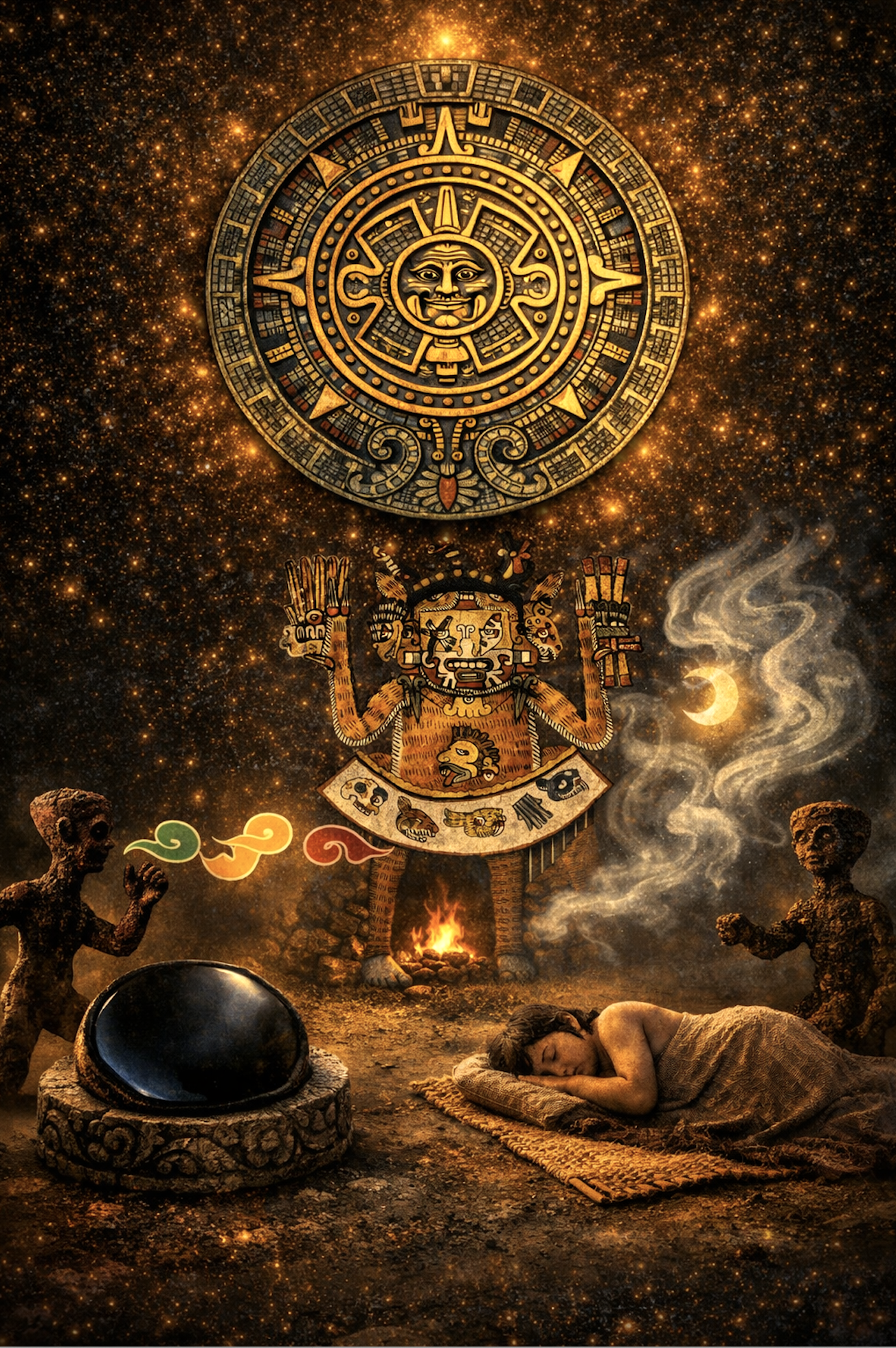
Nemontemi as Purification
Yet Nemontemi are not merely ominous.
They are medicinal.
They are described as days dedicated to purification.
For the obsidian mirror.
For the temazcal.
For meditation.
For sleep.
For immersing oneself in one’s own darkness so that the new cycle may be born.
That is exquisite.
Because what modern culture often calls “doing nothing” is not what this tradition is pointing toward.
Nemontemi are not lazy days.
They are liminal days.
Days for mirror work.
Days for sweat and cleansing.
Days for silence.
Days for dream.
Days for entering the dark without panic.
Days for allowing old structure to loosen so that the next cycle does not emerge contaminated by the unresolved residue of the last one.
In FCD language, this is not inactivity.
It is coherent pause.
It is the refusal to launch from misalignment.
It is the willingness to let the void do its work.
It is the sacred intelligence of not dragging expired structure into emergent form.
Why Nothing New Was Meant to Begin
Within this worldview, the prohibitions of Nemontemi make profound sense.
Do not begin new projects.
Do not undertake new journeys.
Do not marry.
Do not stir conflict.
Do not make offerings casually.
Do not move as if the field were stable when it is not.
These instructions are not random restrictions.
They arise from a coherent principle:
nothing new should be built on unstable ground.
If the count itself is between cycles, then the psyche, the body, the relational field, and the ceremonial field are all in an altered state.
To begin in that condition would be to start from disorder.
How often do we do exactly that in modern life?
We start the new business before grieving the old identity.
We enter the next relationship before ending the last one internally.
We proclaim a breakthrough before our body can hold it.
We ask for abundance while remaining loyal to scarcity.
We initiate from fragmentation and call it vision.
Nemontemi offers a corrective:
wait until time is tied off.
Wait until the field settles.
Wait until the old count is truly complete.
Then begin.
The Equinox and the Tying Off of the Year
There is also the key insight that in this tradition the final Nemontemi day is marked through the equinox sunrise, which signifies the bundling of a completed unit of time.
This gives the ritual threshold an astronomical anchor.
The year is not ended because a page turns.
It is ended because the sky says it is complete.
And every four years, according to this account, the final day of Nemontemi is duplicated or stretched across two days to account for the extra time it takes the sun to return to its original horizon position on the spring equinox. This allows the Tonalpowalli to continue uninterrupted.
Again, there is deep elegance here.
The system stretches to honor reality.
It adjusts to preserve coherence.
It does not cling to artificial neatness when the sky requires a more subtle calibration.
There is medicine in that too.
Sometimes the threshold is longer than expected.
Sometimes the tying off takes more than one day.
Sometimes coherence requires a pause the ego does not understand.
But the extension is not a delay.
It is alignment.
The Feminine Lunar Count and the Last Goddess of the Cycle
Another important layer is the feminine lunar count.
There, the cycle closes with Miquiztli, the action of dying—the last of the 52 essences or goddesses that govern the pre-Hispanic calendar in this framing. Then come Chalchiuhtlicue, Tonacacihuatl, Chicome Cóatl, and finally Xilonen, Lady of Corn.
This sequence is beautiful in its own right.
The cycle closes with death.
Then cleansing.
Then sustenance.
Then karmic reckoning.
Then corn.
Death before nourishment.
Purification before growth.
Darkness before grain.
This is not accidental symbolism.
It reflects a logic of transformation:
first something dies,
then something is washed,
then something is fed,
then something is reckoned with,
then something ripens.
It is a feminine arc of emergence.
1 Rabbit and the Reflection of the 2026 Cycle
Then the new cycle begins. In 2026, this particular turning is named 1 Rabbit.
Rabbit is not presented here as a universal symbol for every cycle.
It belongs to this specific annual threshold and carries the reflection associated with the 2026 cycle.
In this framing, Rabbit may manifest the weaknesses that arise from fear and illusion—or it may carry the possibility of creating a new reflection, until we become “Smoking Mirrors” or gods.
That is what makes this cycle intriguing.
Rabbit here points toward multiplication.
Sensitivity.
Instinct.
Subtlety.
Fecundity.
But also fear.
Projection.
Overreaction.
Unconscious reproduction of pattern.
So the question of the 2026 cycle is not merely: what do you want?
It is:
What are you multiplying?
Fear or coherence?
Illusion or truth?
Bracing or trust?
Reaction or reflection?
Misfortune—or a new field of embodied fortune?
This is not self-help language.
It is ceremonial psychology.
The symbol of this particular year reveals the pattern that may dominate if we remain unconscious, and the medicine available if we become coherent enough to meet the symbol differently.
The Deeper Teaching: Stop Carrying the Expired Count
This is where the tradition reaches directly into modern life.
Many people are still living in an inner Nemontemi.
Something ended, but it was not consciously tied off.
The old count expired, but the psyche is still carrying it.
The body still thinks it is responsible for a world that no longer exists.
A role has ended.
A pattern has ended.
A season has ended.
A false identity has ended.
A structure built around fear, control, performance, or almosting has ended.
But instead of recognizing the completion, most people rush to start something new from the same architecture.
And so the cycle repeats.
This is why the old wisdom matters.
It teaches that emergence without completion is distortion.
A beginning without an ending is contamination.
A new form built from unresolved structure will simply recreate the old pattern in more sophisticated clothing.
The real work is not only calling in the next cycle.
It is letting the previous one end.
FCD and the Obsidian Mirror
In FCD language, Nemontemi belongs to the realm of the obsidian mirror.
The place where image gives way to truth.
Where the self does not perform becoming, but witnesses what is actually complete.
Where the false structure softens.
Where the body tells the truth the mind has been avoiding.
Where silence finishes what strategy cannot.
This is why the teaching feels alive.
Because it is not asking us to become more productive.
It is asking us to become more honest.
What has ended?
What are you still carrying?
What pattern are you reproducing because you never fully tied off the old count?
What if the void is not a problem?
What if the barren days are not punishment, but preparation?
What if the miracle is not in how quickly you begin again, but in how consciously you allow the previous cycle to complete?
This is the medicine of threshold days.
The Year Has Ended
There is something quietly radical in the phrase:
In Xiwitl Intlamiliz.
The year has ended.
Not:
look how new I am.
Not:
watch me begin.
Not:
the future is here.
Simply:
the year has ended.
That statement contains grief, humility, truth, completion, and freedom.
It honors what was.
It ends what is over.
It untangles what no longer belongs.
It makes room without forcing the next form.
And perhaps that is the oldest wisdom hidden here:
before the new cycle can truly begin,
the old one must be ended.
Not conceptually.
Not poetically.
But in the body.
In the psyche.
In the field.
In the mirror.
In the count.
Only then does emergence become clean.
Only then does the next cycle belong to the present rather than the past.
Only then do we stop dragging expired architecture across a living threshold.
And only then can the new reflection—whether Rabbit, Mirror, Corn, or dream—arrive as something more than repetition.
It can arrive as coherence.
It can arrive as a life that is not merely renamed, but truly renewed.
Recent Comments