
The Limits of Modern Healing
For decades, modern healing has largely operated through two primary pathways:
understanding the mind
and
regulating the nervous system.
Talk therapy helped people create narrative coherence around their lives.
Somatic therapies helped people reconnect with the physiological reality of stress, trauma, and survival activation within the body.
Both were important evolutions.
Research in developmental psychology, attachment theory, neuroscience, psychoneuroimmunology, and trauma physiology continues to demonstrate that early relational environments shape emotional regulation, identity formation, behavioral patterning, autonomic responses, and even long-term physiological outcomes.
The body remembers.
The nervous system adapts.
The psyche organizes itself around survival.
Yet beneath the explosion of modern healing modalities, something profound has quietly emerged:
many deeply self-aware people are still suffering.
Not because they are failing.
Not because the modalities are meaningless.
But because insight and regulation alone are often incomplete.
A person can understand their attachment style and still repeat the same relationships.
They can regulate anxiety and still live inside chronic dread.
They can breathe through activation while unconsciously recreating the very conditions generating it.
Many people today have become highly skilled at managing survival responses while never fully uncovering the identity structures beneath them.
This is the modern dilemma.
People know how to cope.
Few know how to emerge.
When Survival Becomes Identity
The nervous system is not only responding to stress.
It is often protecting an identity architecture formed through adaptation.
A child who learns:
“I must be useful to be loved,”
may become an adult who cannot rest without guilt.
A child who learns:
“My emotions burden others,”
may become an adult who disappears inside relationships.
A child raised within unpredictability may become hypervigilant, overproductive, controlling, or endlessly self-monitoring—not because something is wrong with them, but because their organism intelligently adapted to preserve connection, safety, and belonging.
What we often call personality is layered survival intelligence.
The tragedy is not that these adaptations formed.
The tragedy is that many people mistake the adaptations for who they are.
Survival slowly becomes identity.
And once survival becomes identity, even healing itself can unconsciously become another survival strategy.
People begin endlessly optimizing themselves:
- tracking triggers
- monitoring nervous-system states
- collecting modalities
- regulating symptoms
- performing healing
- curating self-awareness
while remaining fundamentally organized around the same unconscious structures first encoded long ago.
This is why many people eventually plateau.
Not because regulation does not work.
Not because insight lacks value.
But because regulation often teaches the system how to survive the pattern,
while deeper transformation requires illuminating the pattern itself.
The Body Is Carrying Unfinished Intelligence
This distinction changes everything.
Regulation helps calm the fire alarm.
But if the original conditions generating the alarm remain unconscious, the system continues recreating the same loops beneath awareness.
The body is not malfunctioning.
The body is carrying unfinished intelligence.
Symptoms are often adaptive signals attempting to restore coherence within a fragmented internal system.
Anxiety is not always pathology.
Hypervigilance is not moral failure.
People-pleasing is not weakness.
Emotional shutdown is not absence of care.
These patterns were often brilliant survival strategies within environments where authenticity once felt dangerous.
The nervous system learned:
- merge to survive
- perform to survive
- hide to survive
- overachieve to survive
- anticipate to survive
- disconnect to survive
And over time, the organism forgets that survival was only ever meant to be temporary.
The Noble Act
Within FCD, these adaptations are understood through the lens of what is called the Noble Act.
The Noble Act in the child is the organism’s sacred protective intelligence arising to preserve continuity of self under conditions that could otherwise become psychologically, emotionally, relationally, or spiritually annihilating.
The child cannot fully process overwhelming environments.
So the psyche intelligently fragments, adapts, shields, suppresses, redirects, performs, scans, disconnects, merges, or hardens in order to preserve survivability.
In this sense, the Noble Act is not pathology.
It is protective grace emerging through adaptation.
The organism says, in essence:
“This pain is too much to fully feel right now and remain intact.
So I will create a way to survive it until consciousness, capacity, embodiment, and safety are strong enough to return.”
That is profoundly different from viewing defenses as weakness or dysfunction.
Within FCD, protectors are often understood as intelligent guardians of unfinished experience.
Not enemies.
Not mistakes.
Not flaws.
Protectors preserve access to the deeper self until the organism develops enough:
- nervous-system capacity
- embodiment
- awareness
- safety
- coherence
- compassion
- differentiation
to reintegrate what was once too overwhelming.
Without adaptation, some organisms might collapse entirely under developmental pain.
So the Noble Act of the child becomes:
the preservation of future possibility.
A bridge across overwhelming experience.
The adaptation says:
“I will hold this pain for now so the deeper self is not completely destroyed by it.”
This is why many survival identities become so rigid and persistent.
They were formed around a sacred biological imperative:
preserve continuity of being.
In very deep FCD language, you could say:
The Noble Act is the organism’s attempt to protect the ember of the divine self until conditions are safe enough for remembrance.
Or:
The protector forms so the soul is not fully consumed by the environment.
But FCD would also carefully ground this understanding.
Not in grandiose spirituality or bypassing.
Clinically and psychologically, this aligns with:
- developmental adaptation
- dissociation theory
- attachment protection strategies
- ego-state formation
- nervous-system survival responses
- fragmentation under overwhelm
FCD simply adds a deeper philosophical lens:
that beneath adaptation there remains an organizing intelligence moving toward coherence and eventual reintegration.
The Adult Noble Act
The important distinction is this:
The Noble Act was necessary then.
But later in life, the same protector structures may continue operating long after the original environment has passed.
That is where suffering begins.
Because the organism is still defending against a world that no longer fully exists in the same way.
So adulthood becomes the gradual process of helping the nervous system realize:
- the danger is not fully present now
- the protector no longer has to carry reality alone
- the fragmented aspects can return safely
- embodiment is possible
- coherence is possible
- remembrance is possible
Not by destroying the protector.
But by honoring the Noble Act it once performed,
while no longer requiring it to run the entire architecture of the self.
The modern self-help world frequently asks:
“How do I feel better?”
A deeper question is emerging now:
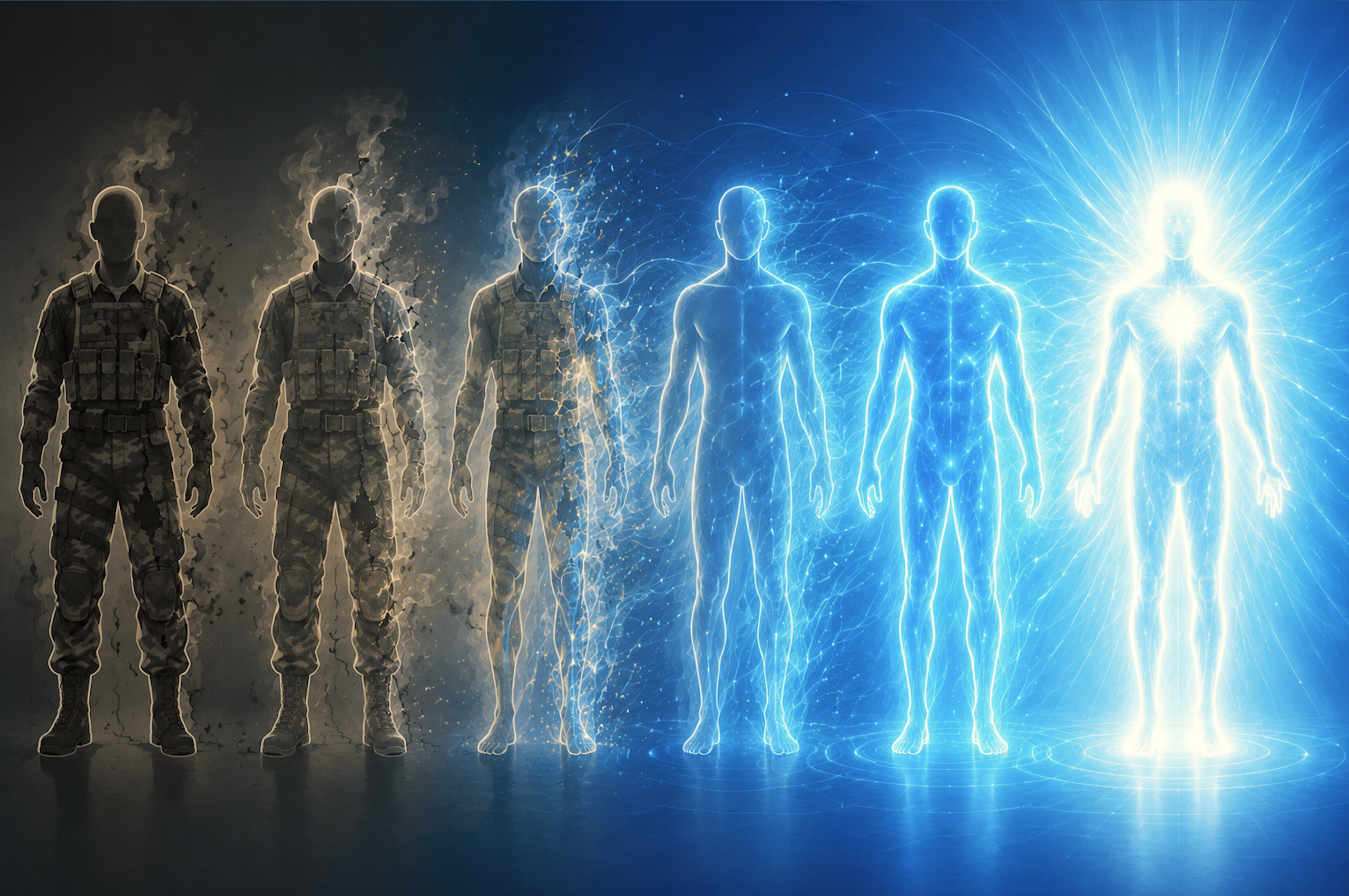
Who was I before survival became my identity?
This question changes the direction of healing entirely.
Because true transformation is not merely symptom reduction.
It is the restoration of inner coherence.
Not the endless management of fragmentation,
but the reintegration of the self beneath adaptation.
The Compassionate Empowered Embodied Emergence Process
At Foundation for Creative Dynamics, this process is not approached as fixing a broken person.
Nothing is “wrong” with the organism.
The body, psyche, and nervous system have been attempting to maintain coherence through whatever strategies once preserved survival.
The Compassionate Empowered Embodied Emergence Process (CEEEP3) recognizes that symptoms are rarely isolated problems.
They are often coherent expressions of unresolved developmental adaptations.
Beneath anxiety may be hypervigilance.
Beneath hypervigilance may be unpredictability.
Beneath unpredictability may be a child who learned safety depended upon constant scanning.
Beneath the scanning may be a protector convinced rest is dangerous.
This is why FCD does not attempt to simply suppress symptoms or create better-performing survival identities.
It assists individuals in remembering.
Remembering the self beneath adaptation.
Remembering the body beneath contraction.
Remembering presence beneath hypervigilance.
Remembering coherence beneath fragmentation.
The Compassionate Empowered Embodied Emergence Process (CEEEP3) is not designed to help people become better versions of their survival identities.
It is designed to assist them in remembering who they were before survival became the organizing principle of the self.
The Process of Remembering
This occurs through a structured process of embodied inquiry, nervous-system awareness, shadow illumination, and compassionate reintegration.
The Flow Process assists individuals in locating unconscious survival patterning within the lived experience of the body itself—not merely as theory, but as direct embodied awareness.
Open Focus assists the nervous system in softening contraction and widening perceptual space so unconscious material can emerge without overwhelming the organism.
Compassionate inquiry and ISS processes assist the present self in reconnecting with wounded or fragmented aspects that were abandoned, exiled, or frozen during earlier developmental experiences.
Protector inquiry reveals how survival identities organize perception, relationships, behavior, achievement, intimacy, creativity, and even spirituality itself.
The Non-Personal Approach assists individuals in loosening over-identification with the pattern so the organism can stop mistaking survival responses for identity.
And stabilization practices restore grounding, embodiment, coherence, and receiving capacity so insight becomes lived integration rather than temporary catharsis.
This is not about endlessly revisiting trauma narratives.
It is about restoring relationship between the present self and the aspects of self that were forced into adaptation.
Because beneath every protector is intelligence.
Beneath every symptom is communication.
Beneath every adaptation is an organism attempting to return to coherence.
Beyond Pathology
Clinical psychology increasingly recognizes that early attachment experiences and chronic stress shape neural development, autonomic regulation, emotional patterning, and behavioral identity structures.
Yet beyond pathology models exists another possibility:
that beneath survival conditioning there remains an undistorted organizing intelligence seeking integration.
Not perfection.
Not performance.
Wholeness.
A state where body, mind, nervous system, emotion, shadow, and creative life force no longer operate in opposition to one another.
A state where presence itself becomes restorative.
Where relationships are no longer organized around unconscious reenactment.
Where the body no longer carries the burden of defending the past.
Where rest no longer feels unsafe.
Where love no longer requires self-abandonment.
Where creativity no longer leaks through survival loops.
Where the organism stops rehearsing protection and begins inhabiting life.
This is not transcendence away from the human experience.
It is embodiment within it.
The Future of Healing
The future of healing may not belong solely to insight.
Nor solely to regulation.
It may belong to integration:
- developmental psychology
- nervous-system science
- somatic intelligence
- shadow integration
- identity differentiation
- embodied emergence
Not merely asking:
“How do I manage myself better?”
But asking the deeper question waiting beneath nearly every symptom:
Who was I before survival became my identity?
IMAGINE. VISUALIZE. PRETEND. MAKE IT UP. REMEMBER.
Recent Comments