
So the Dream That Is Dreaming You Can Finally Dream You?
The Dream Arrives Before Language
Most people never question the dream because the dream arrived before language.
Before philosophy.
Before spirituality.
Before identity became conscious.
The body entered an atmosphere already vibrating with inherited fear, inherited tension, inherited longing, inherited emotional agreements about survival, worthiness, intimacy, power, money, exhaustion, struggle, masculinity, femininity, visibility, safety, and love. Long before a child develops the capacity to intellectually interpret reality, the nervous system is already studying reality directly through embodiment. The body learns from breath patterns before words. From facial tension before explanation. From emotional weather before logic. From what happens in a room when disappointment arrives, when uncertainty enters the house, when conflict appears, when silence becomes heavy, when affection disappears, when stress settles into the nervous system of the adults raising them.
Parents rarely teach children only through advice.
They teach through embodiment.
Parents try to teach what they know, but more often they teach who they are.
A parent may verbally say:
“You are safe.”
But if the body is chronically anxious, emotionally absent, hypervigilant, controlling, exhausted, resentful, frightened by life itself, or quietly disconnected from its own aliveness, the child absorbs that reality long before language can explain it. The nervous system studies coherence before philosophy. A child learns what love feels like by watching how adults respond to emotional intensity. They learn what safety feels like by observing how uncertainty moves through the body of the family system. They learn what worth feels like by discovering whether their existence is welcomed naturally or whether love becomes quietly connected to performance, emotional caretaking, achievement, silence, usefulness, or becoming easy to manage.
And because human beings adapt brilliantly, the child slowly begins constructing an internal dream capable of surviving the environment they entered.
One child learns:
“I must stay alert.”
Another learns:
“It is safer not to be fully seen.”
Another learns:
“If I become useful enough, I will not be abandoned.”
Another learns:
“Love disappears when people become uncomfortable.”
Another learns:
“Rest is dangerous.”
Another learns:
“My value depends on performance.”
These dreams rarely remain intellectual. Eventually they descend beneath conscious awareness and become orientation itself. The body begins perceiving reality through the emotional architecture of what it learned was necessary for survival. The person no longer experiences the dream as a dream. They experience it as reality.
The Exhaustion of Maintaining the Dream
This is one of the deeper realities of the human condition.
The body adapts to survival so thoroughly that eventually the adaptation stops feeling like adaptation at all. The tightening disappears beneath awareness. Protection turns into familiarity, familiarity turns into identity, and after enough years the person can no longer fully distinguish between who they are and what they had to become in order to feel safe.
This is why so much exhaustion exists underneath modern life.
Not because human beings are weak.
Because enormous amounts of life force become trapped maintaining identities originally constructed around adaptation rather than truth.
The overworker may be attempting to outrun collapse.
The hyper-independent person may still be living inside a dream where support disappears.
The endlessly pleasant person may still carry a nervous system terrified of conflict.
The high achiever may still unconsciously believe existence itself must be earned.
The spiritual seeker may still be approaching themselves as someone who requires fixing before they are finally allowed to rest.
And because these dreams become normalized collectively, entire cultures begin reinforcing them. Civilizations slowly organize themselves around inherited nervous-system agreements that few people consciously recognize. Exhaustion becomes admirable. Over-functioning becomes maturity. Productivity disconnected from embodiment becomes virtue. Hypervigilance becomes mistaken for ambition. Emotional suppression becomes interpreted as strength. And perhaps most dangerously of all, society rewards self-abandonment so consistently that people eventually start calling it responsibility.
Meanwhile the body keeps carrying the cost.
People begin living almost entirely oriented toward what could go wrong. The body prepares for disappointment before disappointment arrives. It braces against rejection before intimacy has even deepened. It tightens against collapse before receiving fully opens. It scans for emotional danger before conflict has even appeared. The nervous system becomes emotionally leaned forward into the future, attempting to outrun pain before pain has happened.
And after enough years this constant internal preparation starts feeling normal.
That is the inherited dream.
Not merely a psychological story.
A lived perceptual reality generated through nervous-system orientation, inherited emotional agreements, collective conditioning, unresolved trauma, repeated adaptation, and the agreements human beings unconsciously inherit from the world around them.
The First Dream
The Toltecs understood something most human beings rarely stop long enough to consider: ordinary waking life is itself a form of dreaming.
Not dreaming in the sense of fantasy.
Dreaming in the sense that human beings are constantly perceiving reality through inherited agreements, emotional conditioning, attachment, domestication, fear, memory, identity structures, and fixed patterns of attention. Most people are not experiencing life directly. They are experiencing reality through the dream their nervous system learned was necessary for survival.
This is why there are layers to the dream.
There is the collective dream.
The social dream humanity enters together. Culture. Religion. Family systems. Economics. Gender agreements. Scarcity. Collective fear. Emotional inheritance passed from nervous system to nervous system long before anyone consciously questions it.
Then there is the personal dream.
The individualized emotional reality constructed from childhood experiences, trauma, nervous-system adaptation, attachment, emotional conclusions, repeated self-images, and inherited beliefs about what must happen in order to receive love, belonging, visibility, safety, intimacy, approval, or rest.
Eventually the body becomes so identified with these agreements that the dream itself begins masquerading as objective reality.
That is domestication.
Human beings become hypnotized into inherited emotional agreements about who they must become in order to survive.
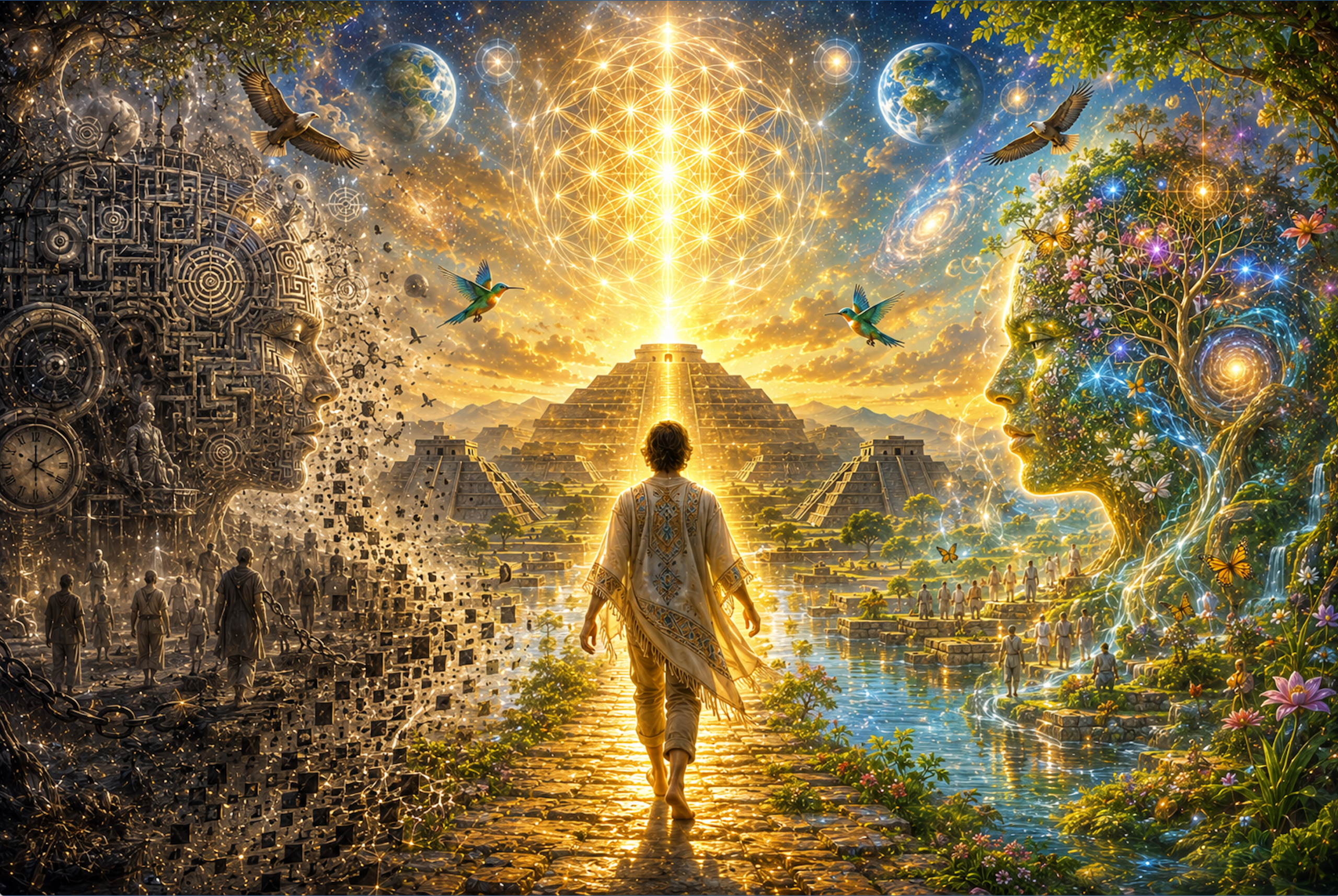
The first dream is the conditioned dream.
The inherited dream.
The survival dream.
The dream organized around fear, identity, scarcity, performance, emotional protection, separation, and the endless effort required to maintain the self the nervous system learned it had to become.
Teotl
And yet, from the deeper Toltec understanding, everything the conditioned self believes “happened to me” never fully happened to the deepest essence underneath identity itself.
The body was touched.
The nervous system was shaped.
The personality adapted.
The psyche fragmented.
The emotional self learned fear, protection, vigilance, shame, scarcity, abandonment, and survival.
But the deeper intelligence underneath the conditioned self was never reduced to those experiences.
The Divine within you was never fundamentally broken by trauma, diminished by domestication, reduced by suffering, or separated from its essential nature. What became wounded was the dream the nervous system learned to survive inside. What became conditioned was perception itself. What became fragmented was identity.
But underneath the inherited dream, something deeper remained untouched the entire time. Not absent. Not destroyed. Not broken. Only obscured beneath identification, fear, emotional memory, and inherited agreements about who you believed you had to become in order to survive.
This is why awakening within these traditions is not understood as becoming divine. It is the gradual loosening of identification with everything you were taught to believe you are not.
The Toltecs called this deeper movement Teotl.
The living force underneath creation itself.
The sacred animating intelligence moving through all life.
Not a distant god watching from somewhere outside existence, but the living field of consciousness expressing itself through all things. A dynamic creative force continuously dreaming reality into being.
And while Teotl itself was not understood as strictly masculine or feminine, the movement of creation emerging from the unseen into form carries what many traditions would recognize as a profoundly feminine quality. Not feminine as gender, but feminine as source, emergence, gestation, intuition, receptivity, creativity, mystery, and the dreaming field from which life itself arises.
Within this understanding, the dream that is dreaming you is not trying to force you into becoming something unnatural. It is attempting to restore you into coherence with what already exists underneath fear, performance, proving, vigilance, and inherited identity. The deeper dream does not demand endless self-construction because it is not attempting to manufacture worthiness. It is attempting to bring the original creative essence back into embodied participation with life.
The masculine movement then becomes the embodiment of that dream into form. Action. Direction. Presence. Structure. Manifestation. The capacity to live, express, protect, and embody what the deeper dreaming intelligence is attempting to create through you.
This is why so many people remain exhausted. The nervous system spends enormous energy trying to maintain the inherited dream while simultaneously resisting the deeper movement attempting to emerge underneath it. One movement is organized around survival and control. The other is organized around participation, coherence, creation, and aliveness itself.
And perhaps this is why stepping outside the inherited dream can feel so disorienting at first, because the body has spent years — sometimes generations — identifying with protection rather than participation. The nervous system learned how to survive the dream, but forgot how to trust the deeper intelligence underneath it.
The work then is not becoming divine.
It is remembering that beneath the conditioned dream, the deepest essence of being was never truly separated from it in the first place.
The Second Dream
But there is another dream underneath the first one.
The second dream.
The dream that is dreaming you.
Not the dream created by fear.
Not the dream inherited through domestication.
Not the dream built from emotional survival agreements.
Something deeper.
Older than identity.
Older than performance.
Older than fear itself.
The Toltecs spoke of Intent.
Nagual awareness.
The dreaming intelligence moving through life before the conditioned mind interrupts it with inherited fear and learned identity.
In FCD language this becomes the Dreaming Universe, the field of coherence, the creative current, the deeper intelligence already attempting to emerge through the body before vigilance, performance, proving, and self-construction begin tightening around it.
The Toltecs were not merely trying to become better versions of themselves.
They were attempting to wake from unconscious participation inside inherited dreams so consciousness itself could begin participating directly with creation rather than endlessly recycling domesticated patterns.
And perhaps that is the real threshold underneath all healing.
Not whether the personality can become more perfected.
But whether the nervous system can loosen its identification with the first dream long enough for the second dream to finally begin living through you.
Stepping Outside the Dream
And perhaps this is where the deeper invitation begins.
Not becoming spiritually superior.
Not transcending humanity.
Not endlessly fixing yourself.
But becoming willing to step outside your inherited dream strongly enough that another intelligence can finally emerge through you.
The dream that is dreaming you.
Not the fearful dream inherited from wounded nervous systems struggling to survive reality.
But the deeper creative intelligence underneath existence itself.
And perhaps the real question underneath all healing, all embodiment, all awakening, all coherence work, is simply this:
Are you willing to step outside your inherited dream long enough for the deeper dream underneath identity to finally live through you?
Because perhaps the deepest tragedy is not that human beings suffer.
Perhaps the deepest tragedy is how many people spend their entire lives defending dreams they never consciously chose, while the deeper dream waiting underneath them never fully gets the chance to dream them into their divine self at all.
Recent Comments